Online Vision Therapy in 2026 – How Teletherapy Works, Effectiveness & What It Costs
This article is educational and is not a diagnosis or treatment plan. Clinical claims should be interpreted with a qualified eye-care professional. See our evidence library and clinical standards for methodology and source context.

What Is Online Vision Therapy?
Online vision therapy is a clinician-guided programme of visual training delivered through software on the patient’s own screen at home, instead of requiring one or two in-office visits every week. It is sometimes called virtual vision therapy or vision teletherapy, and in 2026 it has become the standard delivery model for home-based visual rehabilitation in many developed markets.
The principle is identical to clinic-based treatment: the brain learns new visual habits through frequent, consistent, and progressively harder repetition of specific visual tasks. The difference is where and how that repetition happens. A calibrated screen presents structured visual demands, the software adjusts difficulty in real time based on performance, and the supervising clinician watches the same data from a dashboard rather than from the chair beside you.
This matters because training frequency is the single strongest predictor of outcome in vision therapy. A patient who trains 20 to 30 minutes daily at home accumulates far more therapy hours between appointments than a patient who can only practise what they remember from a weekly office visit. Remote delivery removes the biggest barrier of traditional care — the commute that turns a 20-minute exercise session into a half-day away from work or school.
Online vision therapy covers the full spectrum of functional visual conditions — convergence insufficiency, accommodative dysfunction, amblyopia, strabismus, oculomotor problems after concussion, and many of the complaints associated with prolonged screen use. Modern platforms recreate the graded visual demands that once required stereoscopes, prism bars, and loose lens racks in the clinic, rendering those demands with millisecond timing and precise spatial control on an ordinary display.
Is Online Vision Therapy Effective?
The short answer is yes — for most patients, a structured online programme with clinician oversight reaches outcomes comparable to in-office therapy. The honest longer answer is that effectiveness depends on how the programme is built and who is watching the data.
The landmark Convergence Insufficiency Treatment Trials (CITT and CITT-A) mapped this question more rigorously than any study before or since. They found office-based vergence therapy with home reinforcement to be clearly superior to pencil push-ups and to home-based computer therapy of that era. Those home programmes, however, were first-generation static software with no adaptive difficulty — not the adaptive, clinician-monitored platforms available today.
The 2020s changed that picture. Adaptive software that tunes stimulus parameters in real time, combined with outcomes literature published between 2020 and 2026, shows that hybrid and home-based digitally monitored programmes now achieve results comparable to office-based care for convergence insufficiency, accommodative dysfunction, and anti-suppression training when three conditions hold: a proper diagnosis first, at least four to five training sessions per week, and a clinician reviewing the logged data every two to four weeks.
The strongest model in current clinical practice is hybrid: a comprehensive in-person assessment to diagnose, an online platform for daily supervised training, and clinical reviews every 2 to 4 weeks to adjust the plan. Patients who work this way show outcomes comparable to full in-office programmes for most conditions, at substantially lower cost and far higher adherence.
A caution applies to both models: effectiveness assumes a genuine clinical diagnosis first, a platform with graded stimulus control and data logging, and someone qualified to read the trends. Random free apps provide none of this and are not the subject of this article. When those conditions are met, the distinction between online and in-office matters at the margins, not at the centre of the bell curve — the daily dose of accurate, progressive training is the part that heals, and it travels well.
How a Teletherapy Session Works
A modern online session is a structured, repeatable protocol — not a screen full of toys. Each 20 to 45 minute session follows the same architecture, so the clinician can measure progress session over session:
- A calibration step that aligns the display to your eye height, screen distance, and lighting in about two minutes
- A short warm-up of fixation, tracking, and attention tasks that prepares the visual system for training
- Core protocol blocks — vergence, saccadic, pursuit, and accommodation drills executed on screen with precise timing
- Anti-suppression and binocular integration work using dichoptic presentation, so both eyes contribute and fusion is retrained
- Adaptive difficulty adjustment in real time — the software raises the demand only as fast as you prove mastery
- Automated logging of every response, reaction time and vergence measurement for the clinician’s review
- A closing feedback block that reports fatigue, set targets for the next session, and explains why today’s session mattered
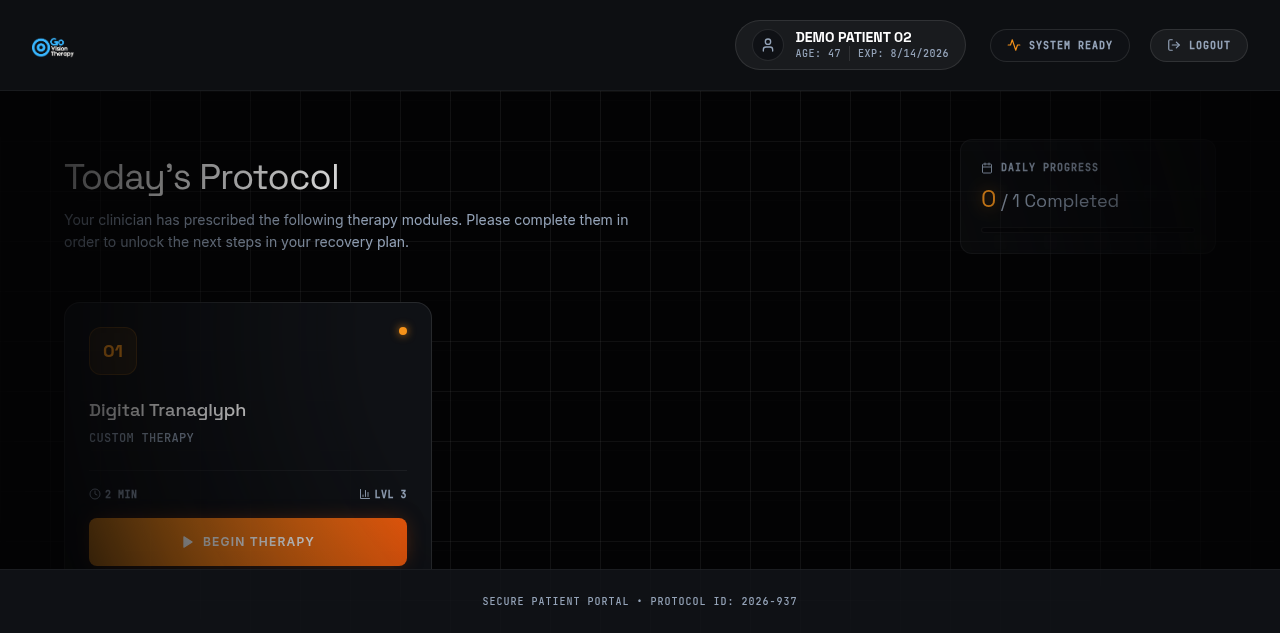
The experience runs entirely in a standard web browser. There is no software installation, no proprietary hardware, and no VR headset requirement for the core modules. GO VISION THERAPY is engineered exactly this way: calibration in the first two minutes, then the exact protocol the clinician prescribed, with the same session data flowing to the patient and the clinician simultaneously.
What You Need at Home
The most surprising thing about modern online vision therapy is how modest the home setup is. A dedicated platform was designed to work with devices most households already own:
- A laptop, desktop or tablet with a modern web browser (Chrome, Edge, Firefox or Safari) and a screen at least 10 inches
- A stable internet connection — ordinary broadband or a solid 4G/5G signal is sufficient for all sessions
- A quiet, well-lit room with low glare and a comfortable viewing distance of about 40 to 60 centimetres
- Any prescription glasses you already wear — therapy is most effective when your usual correction is in place
- Consistent open slots of 20 to 45 minutes, ideally at the same time each day — regularity matters more than the clock
Children complete online vision therapy very well when a parent provides five minutes of setup and encouragement per session. The child does not sit alone with a drill; the parent checks the progress screen and rehearses today’s goal. Practices now prescribe exactly this pattern for school-age patients, and retention for parent-guided sessions is excellent.
Cost Comparison: Online vs In-Office
Cost is where the online-versus-in-office comparison stops being theoretical. In-office vision therapy is delivered by trained clinical staff who run a clinic, so the price reflects room time, personnel and overhead. A typical programme runs 12 to 24 visits.
Totals add up on either side. An in-office course plus travel can exceed USD 2,000; a home platform for a 12-week course often lands between USD 100 and USD 300 all-in. In 2026 several national health systems and a growing number of insurers reimburse teletherapy when prescribed by a licensed optometrist. GO VISION THERAPY individual plans are priced per month with no lock-in, and individual plans in India start at ₹8,999/month.
The correct frame is not cheap home product versus expensive clinic product. It is: the diagnostic assessment is non-negotiable everywhere, and the training dose can then be delivered at home, in the clinic, or both. A fraction of patients will still need regular in-office sessions, and an honest clinic will tell you when. For a deeper breakdown of what drives pricing, see our vision therapy cost and pricing guide. If you want to start free, our round-up of free vision therapy software covers what free tools can and cannot do.
Who Can Do Vision Therapy Online?
Almost every person who can benefit from vision therapy can benefit from a home-based component of it, with two groups standing out: children and adults.
Children aged 5 and up are among the best responders to home platforms, partly because their visual systems are the most plastic and partly because they treat the exercises as play. Many clinics prescribe parent-supervised home sessions between in-office visits precisely because the daily dose drives the change. Adaptive difficulty keeps the ball in the zone: never so easy that it bores, never so hard that it frustrates.
Adults are the fastest-growing segment of online vision therapy. They arrive with exactly the habits that make it work — scheduling, discipline, the ability to train before work or during lunch — and they expect the same quality control from digital care as from any modern subscription. Adult brains retain the neuroplasticity required to respond to vision therapy, a fact supported by the adult studies embedded in the CITT and by the neuro-optometric rehabilitation literature for concussion and binocular dysfunction.
Two honest exclusions: children who cannot yet follow instructions reliably, and patients whose condition needs instrument-based, fully in-office control — prism adaptation therapy, certain orthoptic states, or acute post-operative recovery. For everyone else, expect the clinic to prescribe some home dose.
A Platform Built Online-First
GO VISION THERAPY is online-first not as an add-on but as its architecture. Every module runs in the browser on any device — no installation, no hardware, no VR dependency — and the same session data reaches patient and clinician at the same moment.
Its library spans 32+ modules covering the full inventory of home-based training: vergence facility and jump ductions, accommodation, saccadic and pursuit training, anti-suppression and red-green tasks, fusion ranges, and visual memory. All modules are adaptive and progress through graded difficulty exactly as a therapist would step an exercise in-clinic. The clinical dashboard converts home sessions into progress graphs, vergence ranges, near point of convergence measurements, and symptom trends that drive evidence-informed decisions.
The platform is also remotely monitored: the clinician sees every session, not just the patient’s verbal report. That is the difference between an app and a teletherapy platform, and it is the reason home-based GO VISION THERAPY satisfies the evidence conditions in section II. For a head-to-head view of the options on the market, read our comparison of the best vision therapy software platforms, or browse the full software overview and plans.
Frequently Asked Questions
Yes, for the majority of diagnosed patients who train four to five times per week. Computer-based programmes with adaptive difficulty, data logging and clinical review have closed most of the gap with office-based therapy in the 2020s outcomes literature. The combination that does not work: an incorrect diagnosis, a static non-adaptive app, and no clinician oversight. The diagnosis and the weekly review remain the clinician’s job.
Home platforms typically bill between USD 15 and USD 99 per month, so a typical 12-week course lands between USD 100 and USD 300. An in-office programme is usually noticeably more expensive — commonly USD 500 to USD 2,000 in the United States before travel. Truly free tools exist for mild cases, and there is always the cost of the diagnostic assessment, which is separate and non-negotiable.
Yes. School-age children from about 5 years are among the most responsive participants in home-based programmes; the session format suits the game-like interface, and adaptive difficulty keeps frustration low. A typical schedule is 20 to 30 minutes, five days per week, with a parent present at setup and a clinician review every two to four weeks. Many children these days still do part of their programme in the office — 2026 vision therapy is usually a hybrid.
Yes — that is the strongest recommendation in this article. The optometrist identifies which visual functions need training and in what order: vergence first, anti-suppression second, saccades later. Starting with a random app risks training the wrong systems and losing months. Platforms like GO VISION THERAPY are designed to expect a clinician prescriber, and the diagnosis is what the insurance claim, if any, depends on.
Many patients report changes in comfort and fatigue within the first two to three weeks, while objective measures such as vergence ranges and reading efficiency move meaningfully around weeks 6 to 12. Plateaus are normal — the brain is consolidating, not failing. Because every session is logged, your clinician can show the curve: a flattening trend is the cue to raise difficulty, not a sign that therapy is not working.
They complement each other rather than compete. In-office care is still central for the initial diagnosis, for lens- and prism-based procedures that require equipment, and for patients who prefer physical sessions. Online care provides the daily dose, the data, and the cost efficiency. The evidence-based model in 2026 is coordinated care: clinic for the diagnosis and calibration, home for the repetitions.
- Khatib A et al. AI-Guided Home-Based Therapy for Convergence Insufficiency: A Comparative Feasibility Study with Pencil Push-Ups. Bioengineering (Basel, Switzerland), 2026. PubMed (PMID 42510493)
- Chen AM et al. Effectiveness of vergence/accommodative therapy for accommodative dysfunction in children with convergence insufficiency. Ophthalmic & physiological optics : the journal of the British College of Ophthalmic Opticians (Optometrists), 2021. PubMed (PMID 33119180)
- Zhu W et al. Comparison of a novel gamified binocular therapy and standard monocular patching therapy in treating unilateral amblyopia in young children: a prospective, multicenter, randomized controlled trial. Trials, 2025. PubMed (PMID 40542370)
- Nagendran I et al. The Evolution of Vision Therapy Software and Its Impact on Vision Care - A Comprehensive Major Review. Romanian journal of ophthalmology, 2025. PubMed (PMID 41971215)
Begin Vision Therapy from Home, Guided by a Clinician
GO VISION THERAPY delivers adaptive, clinician-supervised vision training on any device — no hardware, no installation, and 32+ modules used by clinics and patients worldwide.